
Gross Domestic Product by State
- Home
- Statistics
- Economy
- National Accounts
- Gross Domestic Product by State
Gross Domestic Product (GDP) by State, 2025
Gross Domestic Product (GDP) by State, 2024 2 July 2024
Gross Domestic Product (GDP) by State, 2023 27 June 2023
Gross Domestic Product (GDP) by State, 2022 30 June 2022
Gross Domestic Product (GDP) By State 2021 29 June 2021
Gross Domestic Product (GDP) By State 2020 Show all release archives
Overview
MALAYSIA ECONOMIC PERFORMANCE, 2025
Malaysia’s economy remained strong in 2025, with GDP reaching RM1.74 trillion (2024: RM1.65 trillion), sustaining the growth achieved in the previous year at 5.2 per cent (Chart 1). This growth was primarily supported by the Services and Manufacturing sectors, which contributed 82.5 per cent to the total GDP, expanding by 5.4 per cent and 4.5 per cent respectively. The Agriculture sector increased by 2.2 per cent (2024: 3.4 per cent), while the Mining & quarrying sector recorded a marginal growth of 0.6 per cent (2024: 1.2%). The Construction sector continued its double-digit growth of 12.2 per cent (2024: 17.6%).
The Services sector, which is the main contributor to the national economy with a 59.5 per cent share, expanded by 5.4 per cent in 2025, maintaining the same growth rate as the previous year. This growth was supported by positive increases across all key subsectors, namely Wholesale & retail trade, food & beverage and accommodation, which rose by 5.5 per cent (2024: 4.6%), followed by the Utilities, transportation & storage and ICT subsectors at 6.5 per cent (2024: 5.9%). Meanwhile, the Finance, insurance, real estate & business services subsector moderated to 3.8 per cent (2024: 6.6%), Government services increased by 5.5 per cent (2024: 4.7%), while Other services expanded by 6.1 per cent (2024: 5.7%). Johor and Selangor outperformed the national growth rate, 9.9 per cent and 6.0 per cent each.
Chart 1: Annual percentange change in GDP, Malaysia, 1991-2025

Exhibit 1: Economic structure by state and kind of economic activity, 2025

The Manufacturing sector, which accounts for 23.0 per cent of the economy, increased by 4.5 per cent compared to the 4.2 per cent in the preceding year. This growth was driven by an increase in Electrical, electronic and optical products, which strengthened by 9.1 per cent (2024: 4.1%). This was followed by Vegetable & animal oils & fats and food processing products, which rose by 9.4 per cent (2024: 4.9%), as well as Non-metallic mineral products, basic metals and fabricated metal products at 4.0 per cent (2024: 7.5%). Five (5) states outpaced the national growth rate, namely Perak (15.2%), Pulau Pinang (10.0%), Kelantan (9.3%), Kedah and Sabah (5.0% respectively).
The Agriculture sector grew by 2.2 per cent (2024: 3.4%), remaining the third-largest contributor to the national economy with a 6.1 per cent share. This growth was stimulated by the Crops (3.0%) and Livestock (2.2%) subsectors. Conversely, the Fisheries as well as Forestry and logging subsectors contracted by 0.6 per cent and 1.8 per cent respectively. Among the states that recorded growth rates above the national level were Sarawak (4.3%), Terengganu (4.2%), Selangor (4.0%), Kelantan (3.6%) and Pahang, 2.7 per cent.
The Mining & quarrying sector recorded a marginal growth of 0.6 per cent, as compared to 1.2 per cent in the previous year. The Crude petroleum & condensate subsector expanded by 0.2 per cent (2024: -1.3%), supported by Sabah, which rebounded to 5.0 per cent from a contraction of 7.9 per cent in 2024. Meanwhile, the Natural gas subsector moderated to 0.5 per cent (2024: 2.3%), mainly influenced by Sarawak, which recorded a slower growth of 0.7 per cent (2024: 5.4%).
The Construction sector remained encouraging with a double-digit growth of 12.2 per cent (2024: 17.6%), supported by positive growth across all subsectors, particularly the Building construction (14.1%), Specialised construction activities (12.8%) and Civil engineering (8.6%) subsectors. Among the states supporting the strong performance of this sector were Sabah (28.3%), Johor (26.7%), Selangor (16.0%) and Pulau Pinang (13.4%).
Exhibit 2: Economic growth by state and economic activity, 2025

ECONOMIC PERFORMANCE BY STATE, 2025
Turning to economic performance by state, Johor which is the third-largest contributor to Malaysia's economy, strengthened its position by recording a GDP growth of 8.0 per cent (2024: 6.5%), reaching RM170.9 billion compared to RM158.3 billion in the previous year, thereby leading the growth of all other states. The impressive growth was driven by the Services sector, which grew by 9.9 per cent (2024: 6.0%), supported by increases in the Utilities, transportation & storage and ICT subsector as well as Wholesale & retail trade, food & beverage and accommodation subsector. The Manufacturing sector also grew by 4.0 per cent (2024: 4.2%), driven by growth in Electrical, electronic and optical products, as well as Vegetable & animal oils & fats and food processing products. The Construction sector rose 26.7 per cent (2024: 42.4%), propelled by expansion in all subsectors, particularly the Building construction subsector. At the same time, the Agriculture sector grew at a slower pace of 1.1 per cent compared to 5.2 per cent in the previous year, influenced by the Crops subsector particularly oil palm.
Kedah recorded a GDP increase of 4.1 per cent (2024: 4.2%), generating RM56.3 billion compared to RM54.1 billion in 2024. Kedah’s economic growth was led by the Services sector, which expanded by 3.9 per cent (2024: 3.7%), driven by growth in the Government services subsector and the Wholesale & retail trade, food & beverage, and accommodation subsector. The Manufacturing sector, which is the state's second-largest economic contributor, expanded by 5.0 per cent (2024: 6.6%), driven by increases in Electrical, electronic & optical products, as well as Non-metallic mineral products, basic metals, and fabricated metal products. Meanwhile, the Agriculture sector increased by 2.1 per cent, supported by growth in the Crops (oil palm and vegetables) and Fisheries (marine fisheries) subsectors. Nevertheless, the Construction sector contracted of 0.6 per cent (2024: -11.7%), influenced by a 12.2 per cent decline in the Building construction subsector. However, the Civil engineering and Specialised construction activities subsectors expanded by 3.5 per cent and 13.0 per cent respectively, thereby offsetting the sector's decline.
Kelantan’s economy was valued at RM29.8 billion as against RM28.6 billion in the preceding year, increasing by 4.1 per cent against the 3.3 per cent in the same period. The Services sector, which dominates 71.8 per cent of Kelantan's economy, grew by 4.0 per cent (2024: 3.5%), driven by the Government services subsector and the Wholesale & retail trade, food & beverage and accommodation subsector. The Agriculture sector, which is the state's second-largest economic contributor, increased by 3.6 per cent compared to the 1.5 per cent recorded in 2024, driven by the strong performance in the Crops (oil palm and vegetables) subsector. Meanwhile, the Construction sector increased by 8.3 per cent (2024: 18.5%), bolstered by the Building construction and Civil engineering subsectors.
Melaka recorded a GDP value of RM50.3 billion (2024: RM48.8 billion), with an increase of 3.0 per cent (2024: 4.2%). The Services sector, which contributes 52.4 per cent to Melaka's economy, grew by 4.8 per cent (2024: 4.7%), supported by expansion in the Wholesale & retail trade, food & beverage, and accommodation subsector, as well as the Government services subsector. Simultaneously, the Manufacturing sector expanded by 1.1 per cent (2024: 3.8%), backed by Electrical, electronic & optical products and Vegetable & animal oils & fats and food processing. Meanwhile, the Agriculture sector recovered by 1.8 per cent (2024: -2.3%), supported by an increase in the Livestock subsector. Conversely, the state's Construction sector contracted by 4.9 per cent (2024: 27.9%), due to decline in all subsectors, especially Civil engineering subsector.
Negeri Sembilan's economy reached RM55.8 billion (2024: RM54.3 billion), recording a growth rate of 2.6 per cent (2024: 4.6%). The Services sector grew by 3.0 per cent (2024: 4.6%), driven by the Wholesale & retail trade, food & beverage and accommodation subsector, as well as Government services. Simultaneously, the Manufacturing sector grew at a slower pace of 1.9 per cent (2024: 3.9%), weighed down by a contraction of 3.9 per cent (2024: 1.4%) in the Petroleum, chemical, rubber & plastics products. The Agriculture sector also moderated to 1.2 per cent (2024: 8.5%), following a decline of 0.3 per cent (2024: 11.1%) in the crops subsector, particularly oil palm. Similarly, the Construction sector posted a slower growth of 1.2 per cent (2024: 7.5%), contributed by the Specialised construction activities and Building construction subsectors.
Negeri Sembilan's economy reached RM55.8 billion (2024: RM54.3 billion), recording a growth rate of 2.6 per cent (2024: 4.6%). The Services sector grew by 3.0 per cent (2024: 4.6%), driven by the Wholesale & retail trade, food & beverage and accommodation subsector, as well as Government services. Simultaneously, the Manufacturing sector grew at a slower pace of 1.9 per cent (2024: 3.9%), weighed down by a contraction of 3.9 per cent (2024: 1.4%) in the Petroleum, chemical, rubber & plastics products. The Agriculture sector also moderated to 1.2 per cent (2024: 8.5%), following a decline of 0.3 per cent (2024: 11.1%) in the crops subsector, particularly oil palm. Similarly, the Construction sector posted a slower growth of 1.2 per cent (2024: 7.5%), contributed by the Specialised construction activities and Building construction subsectors.
Pahang’s economy performance grew by 3.2 per cent (2024: 5.8%) with a GDP value of RM71.0 billion (2024: RM68.8 billion). The Services sector expanded by 5.0 per cent (2024: 5.0%), driven by the Wholesale & retail trade, food & beverage and accommodation subsector, as well as Government services. Meanwhile, the Manufacturing sector recorded a slower growth of 1.4 per cent (2024: 3.5%), driven by the Petroleum, chemical, rubber & plastics products which is the largest contributor to the sector, grew at a more moderate pace of 1.1 per cent (2024: 2.7%). The Agriculture sector also eased to 2.7 per cent (2024: 9.3%), driven by the crops subsector, registered 3.0 per cent (2024: 13.4%). Within the same period, the Construction sector shrank by 5.3 per cent (2024: 8.6%), owing to a contraction in the Civil engineering subsector of 28.3 per cent. However, the Building construction and Specialised construction activities subsectors recorded a double-digit growth, thereby mitigating the impact of the sector's decline.
Pulau Pinang’s economic landscape continued to show an encouraging performance, recording a GDP value of RM130.3 billion (2024: RM121.4 billion) and an increase of 7.3 per cent (2024: 4.7%), surpassing the national growth (5.2%). Its economy, led by the Manufacturing sector, surged by 10.0 per cent (2024: 4.0%), driven by Electrical, electronic & optical products in tandem with the robust expansion of the global semiconductor and data center hardware markets. The Services sector, which is the state's second-highest economic contributor, expanded by 4.1 per cent (2024: 4.9%), driven by growth in the Wholesale & retail trade, food & beverage and accommodation subsector, as well as the Utilities, transportation & storage, and ICT subsector. At the same time, the Construction sector also strengthened by 13.4 per cent, supported by all subsectors, particularly Specialised construction activities and Civil engineering.
Perak's economy continued to show encouraging growth, expanding by 5.7 per cent (2024: 4.8%) to reach RM91.5 billion, compared to RM86.6 billion in the preceding year. This growth was driven by the Manufacturing sector, which surged by 15.2 per cent (2024: 5.1%), supported by the Transport equipment, other manufacturing and repair products, recorded a favourable growth. The Services sector, also increased by 3.4 per cent (2024: 4.4%), stimulated by the Wholesale & retail trade, food & beverage and accommodation subsector, as well as Government services. The Agriculture sector, which accounts for 13.6 per cent of the state's economy, rose by 1.2 per cent (2024: 5.1%), influenced by marginal increases in the Crops and Livestock subsectors. Meanwhile, the Construction sector increased 8.1 per cent (2024: 11.5%), supported by the Specialised construction activities and Civil engineering subsectors.
Perlis’s GDP expanded by 2.0 per cent (2024: 3.2%), with its economic value reaching RM6.7 billion (2024: RM6.5 billion).The Services sector leads the state’s economy rose by 3.1 per cent (2024: 3.2%), driven by the Government services and the Wholesale & retail trade, food & beverage and accommodation subsector. In contrast, the Agriculture sector as the second-largest contributor to the state’s economy declined by 1.9 per cent (2024: 2.8%), influenced by an 7.2 per cent contraction in the Fisheries subsector. Similarly, the Construction sector declined 8.2 per cent (2024: 12.0%), due to downturns across all subsectors, particularly in the Building construction.
Selangor, which is the main contributor to the national economy, grew by 6.3 per cent (2024: 6.4%) with a GDP value of RM460.1 billion (2024: RM432.9 billion). The state's economy driven by the Services sector, witnessed a 6.0 per cent increase (2024: 6.3%), boosted by the Wholesale & retail trade, food & beverage and accommodation subsector as well as Utilities, transportation & storage, and ICT subsector. Meanwhile, the Manufacturing sector, which accounts for 28.5 per cent of Selangor's economy, expanded by 4.1 per cent (2024: 5.1%), driven by Electrical, electronic & optical products as well as Petroleum, chemical, rubber and plastic products. The Construction sector continued to strengthen, recording a growth of 16.0 per cent (2024: 15.8%), stimulated by the Building construction and Specialised construction activities subsectors. In parallel, the Agriculture sector moderated to 4.0 per cent (2024: 8.1%), influenced by slower growth in the Livestock and Fisheries subsectors. Nevertheless, the robust expansion of the Crops subsector, particularly oil palm and vegetables, supported the overall performance of this sector.
Terengganu’s GDP reached RM40.6 billion (2024: RM40.0 billion) in 2025, expanding by 1.6 per cent compared to the 4.5 per cent recorded in 2024. The Services sector, which drives the state's economy increased by 3.6 per cent (2024: 4.1%) supported by the Government services subsector and the Utilities, transportation & storage and ICT subsector. Meanwhile, the Agriculture sector grew by 4.2 per cent (2024: 3.6%), supported by all subsectors, particularly the Crops subsector. Contrarily, the Manufacturing sector contracted by 1.2 per cent (2024: 3.9%), affected by declines in Petroleum, chemical, rubber & plastic products, which account for 94.5 per cent of the state's Manufacturing sector. The Construction sector in Terengganu also declined by 5.8 per cent (2024: 17.5%), influenced by downturns across all subsectors, notably in the Civil engineering subsector.
Sabah’s economic performance is reflected in its GDP value, which amounted to RM88.8 billion (2024: RM84.5 billion), increased by 5.1 per cent compared to the 1.2 per cent recorded in the previous year. The Services sector as the main contributor to the state’s economy grew by 4.5 per cent (2024: 4.2%), driven by tourism-related subsectors such as Wholesale & retail trade, food & beverage and accommodation, as well as the Government services subsector. The Mining & quarrying sector as the second-largest contributor to Sabah’s economy, rebounded to 4.9 per cent (2024: -4.9%), following an increase in the production of Crude petroleum & condensate and Natural gas. The Agriculture sector recovered by 0.9 per cent (2024: -3.2%), driven by growth in the Crops subsector, specifically oil palm. The Manufacturing sector also rose by 5.0 per cent (2024: 1.2%), propelled by Vegetable & animal oils & fats and food processing products. Meanwhile, the Construction sector in Sabah strengthened by 28.3 per cent (2024: 21.5%), driven by growth across all subsectors, particularly in the Civil engineering subsector.
Sarawak’s economic value, which reached RM153.5 billion (2024: RM148.2 billion), recorded a growth of 3.6 per cent (2024: 3.8 per cent). The Services sector grew by 5.4 per cent (2024: 4.8%), driven by the Wholesale & retail trade, food & beverage and accommodation as well as the Utilities, transportation & storage, and ICT subsector. The Manufacturing sector increased marginally by 0.1 per cent (2024: 1.3%), affected by a decline in Petroleum, chemical, rubber & plastic products, which account for over 80 per cent of this sector. Meanwhile, the Mining & quarrying sector grew by 2.7 per cent compared to the 4.8 per cent recorded in the previous year, influenced by a marginal increase in the Natural gas subsector, which contributes 72.2 per cent to this sector. The Agriculture sector in the state expanded by 4.3 per cent, driven by the growth of the Crops subsector, particularly oil palm. Meanwhile, the Construction sector increased by 10.9 per cent, supported by the Civil engineering and Building construction subsectors.
W.P. Kuala Lumpur remained the second-highest contributor to the national economy with a GDP value of RM265.1 billion (2024: RM251.9 billion), expanding by 5.2 per cent (2024: 6.2%). The Services sector which dominates its economy with a 91.7 per cent share, increased by 5.2 per cent (2024: 5.6%). This increase was supported by the Wholesale & retail trade, food & beverage and accommodation as well as the Finance, insurance, real estate & business services subsector. Meanwhile, the Construction and Manufacturing sectors increased by 6.0 per cent and 3.0 per cent respectively.
W.P. Labuan’s economy recorded a GDP value of RM8.7 billion (2024: RM8.6 billion) expanding by 1.7 per cent (2024: 5.3%). This growth was led by the Services sector which expanded by 2.1 per cent (2024: 6.3%), supported by the Finance, insurance, real estate & business services subsector. The Construction sector expanded by 2.2 per cent (2024: 3.1%), driven by positive growth in the Specialised construction activities and Building construction subsectors. Meanwhile, the Manufacturing sector grew marginally by 0.1 per cent (2024: -0.7%), influenced by a decline in Petroleum, chemical, rubber & plastic products.
W.P. Putrajaya's GDP value increased to RM14.4 billion compared to RM13.7 billion in the previous year, thereby recording a growth of 4.8 per cent (2024: 5.2%). The Services sector, which dominates its economy, grew consistently at 5.0 per cent (2024: 5.0%). This growth was supported by the Government services and Wholesale & retail trade, food & beverage and accommodation subsectors. Meanwhile, the Construction sectors increased by 0.9 per cent as compared to 9.3 per cent in the previous year.
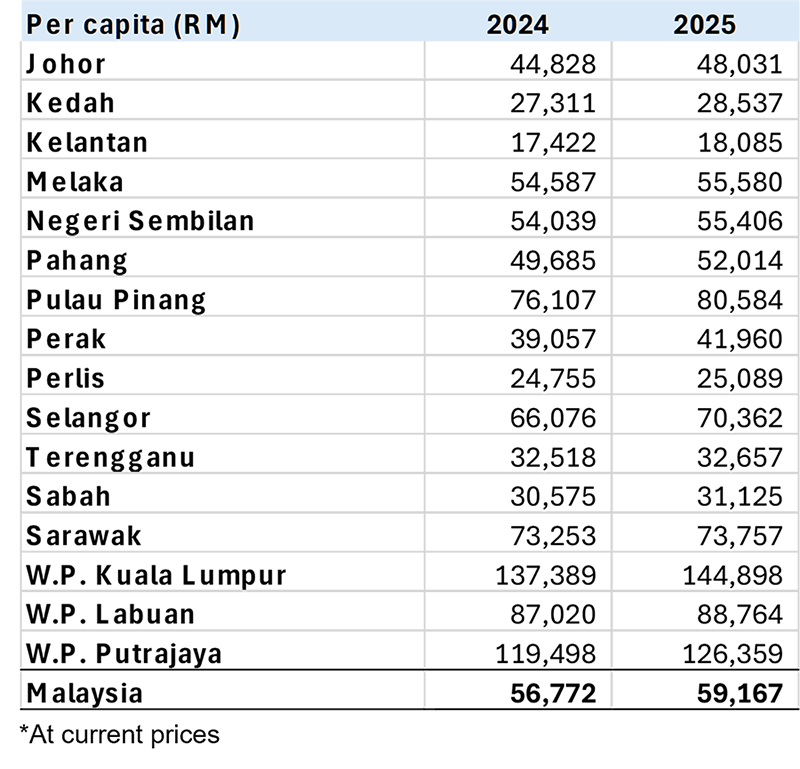
GDP PER CAPITA
Table 1: GDP per capita (RM) by states, 2025
Press Statement
Subscribe

Newsletter
Subscribe to our newsletter and stay updated

For interviews, press statement and clarification to the media, contact:
Baharudin Mohamad
Public Relation Officer
Email: baharudin[at]dosm.gov.my
Phone: 03 8090 4681
Not found what you looking for? Request data from us, through
Go to eStatistik
Email: data[at]dosm.gov.my
Phone: 03 8885 7128 (data request)